
[Page Updated 2 November 2025]
If you want to read info about this website – click here.
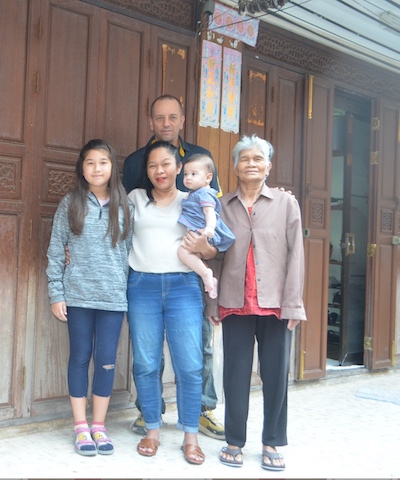
If you want to read about “Vern” – the owner of this site, read on.
I’m Vern Lovic. I’m an American from Pennsylvania originally. I’m currently living in Southern Thailand in a province and city named Krabi. I have been here in Thailand for 20 years. I am a meditation teacher, meditation coach, and author. I can coach you in how to prepare for Jhana if you’d like to reach it or how to go further if you are already able to reach it.
I became interested in meditation on the breath through a series of things that led me to it.
I had a World Religion class at university. I looked at Buddhism, Sufism, Hinduism, Hare Krishnas, and some other religions. Our teacher was a Jewish man who had a very open-minded approach to religion. It was exactly what I needed, having grown up Roman Catholic, then my mother turned born-again Christian when I was 13. My brother and sister were moved to a Christian private school at that time. I was allowed to remain in the public high school because I was playing soccer.
I consumed books by Alan Watts, Jiddu Krishnamurti, UG Krishnamurti, DT Suzuki, Joseph Conrad, and many more. I probably read a hundred books during a short time. From there, through my father in law Dr. Suporn Supawanich, I found Buddhadassa Bhikku, Ajahn Chah, Thich Nhat Hanh, and some other meditation teachers – mostly from the Thai Theravada Buddhist Forest Tradition.
My father in law taught me to meditate on the breath in the forest tradition like he was taught. I began experimenting with all the different things I read from various teachers too. I incorporated periods of mindfulness into my day along with a simple sitting meditation practice of around 20 minutes at the end of the day.
Over time I reached some nice ‘feel good’ states of mind that everyone seems to think meditation is all about. It was nice, but I wondered about working on my concentration. I had ADD/ADHD and I’d never been able to concentrate on anything for more than a few minutes.
I experimented with various ways to concentrate on the breath. Eventually I found something that I stuck with.
In my practice, I pulled the bare essence from Buddhist meditation and Vipassana meditation. I didn’t follow any of the precepts, didn’t believe in past lives, and didn’t try to eliminate any fetters before meditating.
The result was a very quick path through the Jhanas and even into some Abhinna experiences.
Recently I did a video about my current state of progress. You can view it below on this page. In October 2019, I added this page about the state which is known by some others as non-dual awareness.
I am not Buddhist or any other religion. I think religion is unnecessary to reach Jhana in meditation, and I honestly believe that Buddhism is teaching meditation incorrectly when it comes to reaching Jhana. I think the few number of monks who are able to reach Jhana is a good indication of the lack of success of Buddhism in teaching meditation.
If you’re interested in listening to MP3 audio, I have a fairly detailed history of my meditation experience in an audio file here.
I also have a video telling some of my background, which is much newer than the audio – Vern’s Background.
I meditated nearly daily for about a year back in 1997-1998 and have continued meditating intermittently for 29 years. My meditation today looks nothing like my early attempts. Some changes took place over time and I have reached some sort of really nice state.
Initially, I was looking at meditation as a purely physical experience. I wanted a way to relax after days filled with stress at my job. I decided to do away with the religious aspects so entangled with meditation and then distilled the process down to just its bare-bones physical practice.
I had very few rules in mind as I sat down. I had no idea that it could lead to anything other than relaxation. I was doing it just to do it. The reward was basically just being able to sit in silence for twenty minutes a day without having to think about anything else.
It was like playing a game with my mind every day. It wasn’t “fun” per se, but it was interesting because gradually my mind started to change.
There is an incredible series of changes that take place in the mind as one sits and looks at what goes on. Eventually, it stops. Thought stops. The mind stops. What happens then cannot be described… it is beyond normal experience… so different that words don’t have the ability to describe it at all. It doesn’t matter how much I write or say about the experiences that happened, I feel like I’m only just barely touching the surface. For me to give you a clear description of the experiences is impossible. The experiences don’t lend themselves to such an explanation.
I wrote a few books to help people with a good path that can change their lives. Basically, the books cover the process of meditation without adding any religion to it. However, when I titled the book that way, “Meditation Without Religion,” very few people read it. I retitled it, “Meditation for Beginners – a 22 Day Guide” and now it has sold more than 35,000 copies. Ahhh, marketing. 😛
I have another book, Meditation for Beginners – Secrets for Success. This second book goes deeper. Really, the first book is all you need, and the second book gives much more description and details.
You honestly don’t need the second book, but most people find it very interesting because it gives more details and more of the big picture.
I recently finished “DEEP JHANA – Total Ego Annihilation” and published it at Amazon as well. This one details everything you’d need to know to follow a path similar to mine.
If you have read either one, would you let me know what you thought of it?
Disclaimer: I am not a guru of any sort. I don’t know much about the intricacies of Buddhist meditation, because I didn’t want to be overly influenced by it in my practice. I have enjoyed experiences that appear to be similar to some of what the Buddha described. Though we’ve come to our results in a different way.
I don’t know what enlightenment means. I am not looking for it, and I am not sure it exists. I asked myself for years whether it was something I should move toward. I finally got my answer in 2007. Buddhist “enlightenment” isn’t the only change available to us as human beings. There is more. There is potentially a lot more. Many ways to get there. Many different ‘end games.’
I think the experiences meditation brings are available to everyone – but the primary stumbling block is that meditators don’t want to do the ‘work’.
It’s work to sit there on the floor and envelop yourself in silence, watching the mind take you away from focusing on the feeling of breath at your nose. You might feel like you’re not progressing at all for weeks at a time. That is precisely when you are progressing… you are training your mind to deal with the task at hand.
It is getting better over time and it isn’t a straight line of improvement on a graph.
Once you have a breakthrough and the mind begins slowing down the churning out of thoughts and concentration increases to seconds and then minutes and hours – you begin to see phenomenal changes occur.
I’ve looked for over a decade to find others who have gone into Jhana during and outside of meditation sessions. I have found very few people who have had the tenacity to stick to the basic agenda I outline in the book. But still, there are some!
Meditation is, in a way, a game to be won. You are playing against your mind. It is your mind playing your mind. When the mind stops – when you’ve let go of every distraction and focused and refocused back on the feeling of your breath at the nose thousands of times, maybe tens of thousands of times… the mind slows and eventually even stops completely. It just flatlines.
I’d love for you to experience the silence that occurs when the mind stops and thoughts are no longer created. I can never explain it to you, but I can say that it is one of the most interesting states of consciousness I’ve ever experienced. A lot of teachers call it a Non-Dual State.
Timeline
1995-1997 I read books on Eastern religion and Eastern philosophy. I read books about Zen Buddhism, Theravada Buddhism, Mahayana Buddhism, Hinduism, Sufiism, and the Theosophical Society. I read about Jiddu Krishnamurti, UG Krishnamurti, Thich Nhat Hanh, and many others. I was curious to find out about other belief systems and ways of approaching problems I saw in the world, and in myself.
1997 I began meditating. I meditated with my father-in-law at the time. He was a Thai Buddhist living in the USA for decades. He taught a small group meditation a couple of times a week. He showed me how he meditated. He told me about forest temples and forest retreats in Thailand.
He shared with me his library of books written by some forest monks he liked. I read books about the teachings of Buddhadasa Bhikku from Suan Mokkh temple in Chaiya, Surat Thani, Thailand. I read books about Ajahn Chah in the northeast province of Ubon Ratchathani at Wat Pah Nanachat and Wat Nong Pa Pong temples (among others).
I enjoyed the idea of Buddhism more than Christianity, but I didn’t want to follow any religion. Curiously, Buddhadasa has a book called “No Religion” you might be able to find online somewhere. I have a couple of copies in storage.
1997 I read a book by S.N. Goenka about Vipassana meditation. I liked how the physical process looked. It copied what the Buddha was said to have done thousands of years before. I took some time to read the entire book and take notes on the physical aspects of the practice.
I wrote down a guide for myself to follow that became my meditation practice. It included sitting meditation, walking meditation, mindfulness of the present moment, and a lot of questioning. I began practicing in my bedroom for 20 minutes a day to relax from stressful days at work as a home inspector and real estate agent in Tampa, Florida.
1998 After a few months of practice (and I’m leaving out thousands of experiences) I noticed very clear changes in my behavior. I had a tool to help calm me down not only during meditation but during stressful moments in my day. I saw the immense benefit of continuing to practice.
I hadn’t yet been able to reach samadhi, or total concentration on the breath without extraneous thoughts, but I had brief moments where I was able to. There were many interesting and sometimes bizarre experiences that resulted. This kept the practice interesting, but to be honest, if there were no strange experiences I would have kept up the practice because the other benefits were tangible.
Post 1998 So much has happened. I think it best to start with the audio files I posted above that detail some of what happened during meditation. Without even knowing what states I was reaching, I was in and through the 8 jhanas. I also experienced some of the abhinnas briefly.
I’ve reached a point now where there is no reason to practice. The changes have been made and I’m a completely different person. A better person. A more empathic and compassionate person. A person less filled with ego and selfishness. I enjoy some sort of state of mind that one might say is split or multi-layered.
I think the video below would be best to listen to.
I hope you enjoy this website. If you have any questions, do feel free to ask.
Vern Lovic @quora, @youtube, @email, JhanaMeditationCoach@twitter.
Video about my current state
